

Puerto Rico as a Strategic Geolocation for AI Drone Operations — Powered by AI-Ready Tactical Data Centers
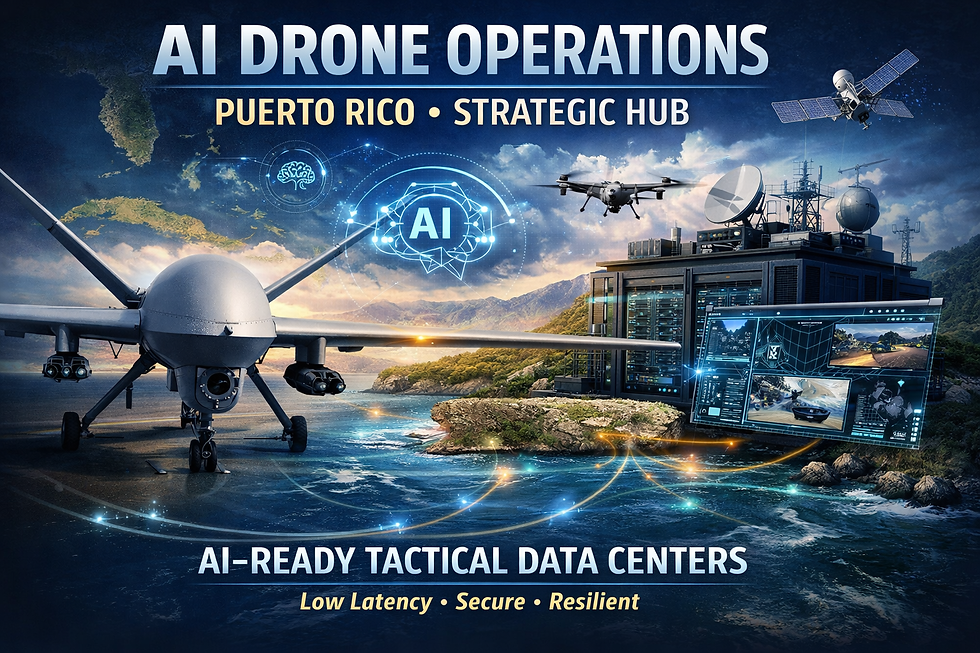
Puerto Rico sits at a rare intersection: U.S. jurisdiction and airspace integration, direct reach into the Caribbean/Atlantic, and proximity to Central and South America—while still being close enough to the continental U.S. to support logistics, command-and-control, and rapid deployment. That combination makes the island a strong “forward node” for AI-enabled drone missions that need low latency, resilient connectivity, and secure compute.
Open-source reporting in 2025 has highlighted Puerto Rico’s growing operational relevance in the region, including U.S. activity staged from locations like Roosevelt Roads, and imagery showing MQ-9 Reaper drones on the ground at Rafael Hernández Airport (Aguadilla). The War Zone+1
Why geolocation matters for AI drones
AI drones are no longer “just aircraft.” They’re sensor platforms + compute pipelines. The closer your compute and decision loops are to the mission area, the more you can:
Stream higher fidelity video/telemetry with fewer dropouts
Run real-time inference (tracking, detection, anomaly scoring) at the edge
Reduce time-to-decision for command staff
Keep data processing inside controlled jurisdictions and security boundaries
That’s where AI-Ready Tactical Data Centers come in—purpose-built, resilient facilities (or modular containerized stacks) that keep AI workloads running through power events, comms disruptions, and surge operations.
Puerto Rico’s “data gravity”: cables, landing stations, and resilient routes
Drone operations at scale quickly become a networking problem: multi-sensor streams, storage, AI training, and secure distribution to agencies and partners.
Puerto Rico is actively investing in improving resilience of submarine cable infrastructure—explicitly addressing single points of failure by planning additional landing stations (West/South/East) and subsea fiber connectivity. smartisland.pr.gov
Private sector connectivity is also expanding across the region. For example, Telxius announced an in-service route/extension connecting the Dominican Republic to Puerto Rico and linking onward to the U.S. and broader LATAM via major cable systems. telxius.com
Undersea cables are also a national-security concern because they carry the vast majority of international data traffic, making resilient and well-governed connectivity strategically important. Reuters
A real example of “AI-Ready” infrastructure in Puerto Rico
Facilities like HUB787 market themselves specifically as resilient, interconnection-rich environments suited for edge compute and high-performance workloads. HUB787 states it is designed to ANSI/TIA-942 Tier III availability (99.982%), operated through the 2017 hurricanes on generators for 42 days, and capable of ultra-low latency within Puerto Rico (claimed ~1 ms). hub.pr
Whether you use HUB787, build your own hardened stack, or deploy modular micro-data-centers, the takeaway is the same: Puerto Rico can host serious “edge-to-core” compute for drone AI missions.
What an AI-Ready Tactical Data Center needs to support drone missions
For drone operations, “AI-ready” isn’t a buzzword—it’s a checklist:
Resilience
Redundant power (UPS + generator, ideally hybrid microgrid-ready)
N+1 cooling and environmental monitoring
Rapid serviceability and spare parts strategy
Performance
GPU-capable compute for inference + model training
High-throughput storage (video is brutal)
Low-latency interconnects to landing stations/ISPs + private backhaul options
Security
Zero Trust network segmentation (mission VRFs, isolated video networks, secure admin plane)
Strong key management, encryption, logging, and audit trails
Controlled data egress to cloud/partners (policy-based replication)
Deployability
Ability to “push compute forward” (portable racks / rugged cases / container modules)
Satellite + cellular + terrestrial failover routing
The AI Drone Mission Stack (Puerto Rico–optimized)
A practical reference architecture looks like this:
Drones / UAS payloads
EO/IR video, thermal, LiDAR, ADS-B receive, RF sensing (mission-dependent)
Edge inference (near-real-time)
Onboard or ground/vehicle compute: detection, tracking, geo-tagging, event triggers
Tactical Data Center (Puerto Rico core edge)
Video ingest + evidence-grade storage
Cross-camera analytics, model retraining, dataset governance
Command dashboards (common operating picture)
Secure distribution
Streaming to EOCs, maritime ops centers, incident commanders
Controlled sync to cloud for long-term archiving, interagency sharing, and large training jobs
Compliance baseline (U.S. territory advantage)
Because Puerto Rico is a U.S. territory, commercial and many public-sector drone programs align to FAA frameworks like:
Remote ID requirements for drones that must be registered Federal Aviation Administration
Part 107 operating rules for small UAS, including conditions for night ops and operations over people/vehicles when requirements are met Federal Aviation Administration
That helps reduce friction for organizations that need scalable, compliant operations—especially when paired with secure data handling and audit-ready infrastructure.
Use cases where Puerto Rico becomes a “regional AI drone tell”
Maritime domain awareness (coastlines, ports, trafficking interdiction support, SAR coordination)
Disaster response (damage assessment, route clearance, infrastructure inspection after storms)
Critical infrastructure (energy, water, telecom site inspection and perimeter monitoring)
Environmental monitoring (wildfire risk, watershed observation, protected areas)

$50
Product Title
Product Details goes here with the simple product description and more information can be seen by clicking the see more button. Product Details goes here with the simple product description and more information can be seen by clicking the see more button

$40
Product Title
Product Details goes here with the simple product description and more information can be seen by clicking the see more button. Product Details goes here with the simple product description and more information can be seen by clicking the see more button
$50
Product Title
Product Details goes here with the simple product description and more information can be seen by clicking the see more button. Product Details goes here with the simple product description and more information can be seen by clicking the see more button.
$50
Product Title
Product Details goes here with the simple product description and more information can be seen by clicking the see more button. Product Details goes here with the simple product description and more information can be seen by clicking the see more button.


Comments