

Platforms and Deployment Form Factors for AI-Ready Tactical Data Centers
Updated: Feb 18
C5ISR doesn’t live in slide decks. It exists in real terrain, real weather, and real failure modes. Communications degrade, power fluctuates, and teams must still execute.
That’s why ORVIWO builds AIRTDCs (AI-Ready Tactical Data Centers) as deployable platforms, not theoretical architectures. The same compute-and-governance core can be packaged into multiple form factors based on mission tempo, endurance, and payload requirements:
Vehicles for rapid mobility and immediate C2/ISR
Trailers for scalable capability with fast setup
Containers for sustained operations and higher-density compute
This post breaks down what each platform is best for—and how to choose the right one.

What is an AIRTDC?
An ORVIWO AIRTDC is a mission-ready compute core. It packages GPU-ready compute, evidence-grade storage, resilient networking, observability, and Zero Trust + AI governance into a deployable platform. This platform can operate in normal, degraded, or denied conditions.
The Platform Decision: Speed vs. Endurance vs. Scale
Most teams choose platforms based on what looks impressive. ORVIWO selects platforms based on what keeps operations alive:
Speed: How fast can you move and re-position?
Endurance: How long can you operate without “perfect support”?
Scale: How much compute/storage/network can you sustain?
Setup burden: How many people and how much time does it take to deploy?
Governance: How well can you control access, logging, chain-of-custody, and auditing?
Let’s break it down by form factor.

1) Vehicle-Based AIRTDCs (AIRTDC-V)
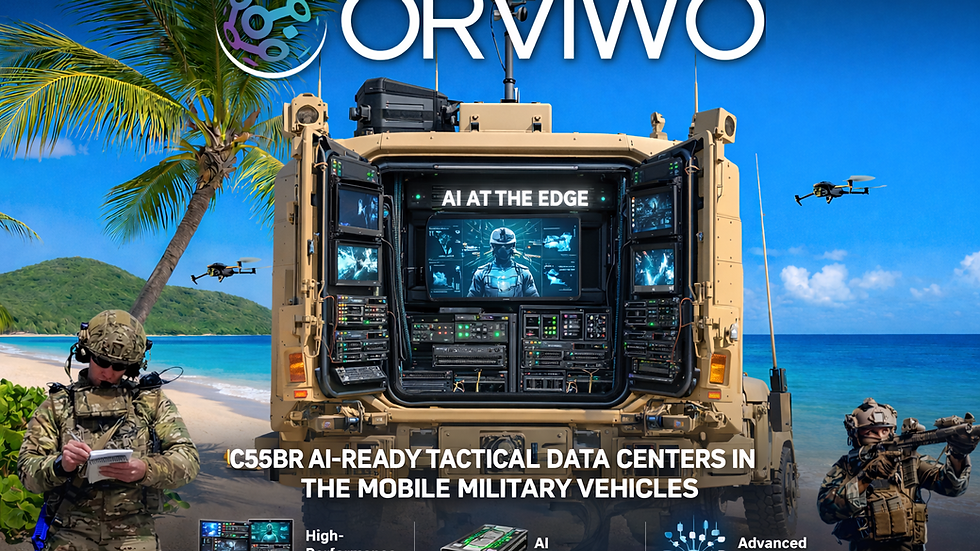
Mobile C5ISR and Edge Compute
A vehicle-based AIRTDC transforms a platform into a mobile node for command, communications, and edge analytics. This is ideal when time-to-deploy is measured in minutes.
Best for:
Mobile command posts / tactical operations centers (TOC)
Convoy operations and route security
Rapid ISR processing (UAS video, cameras, LPR, RF)
Incident command for public safety and disaster response
Field teams that must operate while moving and repositioning
Strengths:
Fastest deployment and redeployment
On-scene compute and communications without building a site
Ideal for “degraded mode” response where cloud reachback is unreliable
Considerations:
Limited rack space and power headroom compared to trailers/containers
Thermal and vibration constraints require ruggedization discipline
Compute density is optimized, not maximized
ORVIWO Approach:
We build vehicle AIRTDCs as modular kits: network module, compute module, storage module, and governance/monitoring—allowing capability expansion without redesigning the platform.
2) Trailer-Based AIRTDCs (AIRTDC-T)
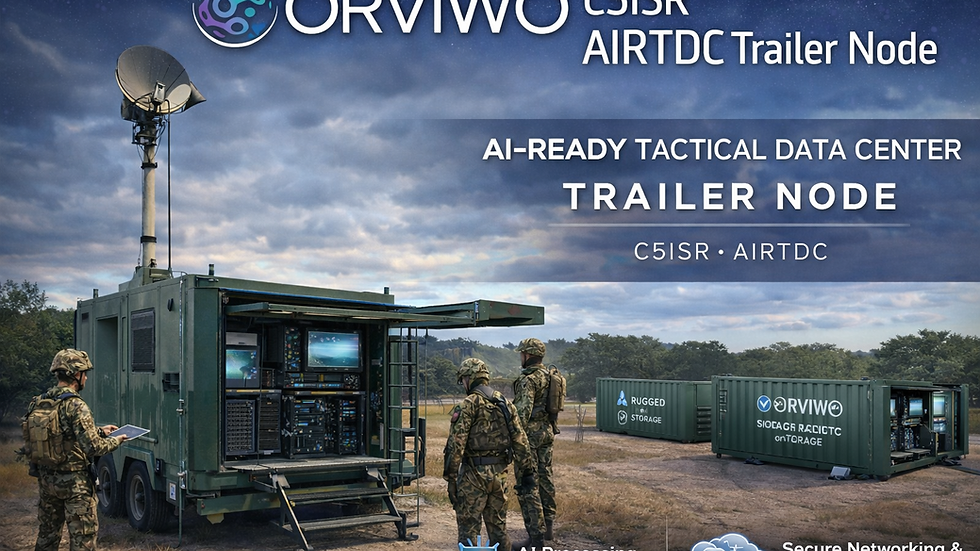
The Scalable, Fast-Setup Edge Site
Trailers often represent the “sweet spot” between mobility and capability. They provide more payload capacity than a vehicle while still enabling deployment in hours—not days.
Best for:
Deployable incident command and communications hubs
Forward staging areas and temporary mission sites
Multi-agency operations requiring controlled collaboration
Field analytics and data capture with stronger storage retention
Rapid surge capacity for exercises or response operations
Strengths:
More compute/storage/power capacity than vehicles
Easier maintenance access and upgrade cycles
Can be staged and repositioned without tying up a mission vehicle
Supports stronger redundancy (WAN failover, UPS depth, spares)
Considerations:
Requires a tow vehicle and slightly more setup coordination
Site selection matters (security, power, line-of-sight)
ORVIWO Approach:
Trailer AIRTDCs are built to support Tiered packages (Lite / Standard / Heavy). This allows scaling from communications + small compute to GPU edge clusters without changing the operating model.

3) Containerized AIRTDCs (AIRTDC-C)
The Sustained, High-Density “Field Data Center”
Container AIRTDCs are the platform for endurance and scale. They support higher compute density, longer retention, and more consistent operations.
Best for:
Sustained base operations and joint hubs
Port, airport, and critical infrastructure sites
Data-heavy ISR fusion and analytics
Multi-tenant separation for interagency collaboration
Environments requiring repeatable “data center discipline” at the edge
Strengths:
Highest compute and storage density
Better environmental control and physical security options
Repeatable rack layouts and standardized sustainment
Supports longer operations and broader workloads
Considerations:
Heavier logistics footprint and longer deployment timeline
Power and thermal planning becomes a primary design factor
Best used as a “hub,” with vehicle/trailer nodes feeding into it
ORVIWO Approach:
We design container AIRTDCs to operate as edge hubs that support downstream nodes (vehicles/trailers) through controlled data sharing, replication, and governance.
A Simple Selection Guide (Mission Fit)
Choose Vehicle when:
You need minutes-to-operate
The mission requires constant movement
You need on-scene C2 + analytics now
Choose Trailer when:
You need more capability but still want rapid deployment
You want a deployable hub that can be staged and relocated
You need stronger redundancy and storage retention
Choose Container when:
You need sustained operations and higher compute density
You’re supporting multi-team / multi-agency collaboration
You want the most standardized, repeatable “edge data center” form factor
The ORVIWO Deployment Architecture: Hub-and-Spoke (Edge-to-Core)
The best deployments are rarely “one platform.” They are an ecosystem:
AIRTDC-V (Vehicle): on-scene, rapid response node
AIRTDC-T (Trailer): forward hub / surge site
AIRTDC-C (Container): sustained edge data center hub
All three operate under the same principle: Humans hold authority. Machines provide advantage. Governance keeps it lawful, stable, and auditable.
That governance layer allows collaboration without compromising security.
What ORVIWO Delivers (Platform Packages)
ORVIWO provides end-to-end deployment—not just equipment:
Platform selection and mission-fit design (vehicle/trailer/container)
Compute + storage + network blueprint (scaling tiers)
Zero Trust segmentation + identity and access controls
Observability dashboards and operational telemetry
Chain-of-custody and retention workflows (where required)
SOPs for normal / degraded / denied operations
Training, tabletop exercises, and sustainment reporting
Closing Thought
AIRTDCs are not just about “having a data center.” They ensure that C5ISR remains operational when reality is hostile. They also guarantee that AI stays governed, auditable, and trustworthy within command authority.
If you’re planning a vehicle-based node, a deployable trailer hub, or a containerized modular data center, ORVIWO can deliver a reference architecture tailored to your mission and environment.
Contact ORVIWO to schedule a technical discovery call.

$50
Product Title
Product Details goes here with the simple product description and more information can be seen by clicking the see more button. Product Details goes here with the simple product description and more information can be seen by clicking the see more button

$40
Product Title
Product Details goes here with the simple product description and more information can be seen by clicking the see more button. Product Details goes here with the simple product description and more information can be seen by clicking the see more button
$50
Product Title
Product Details goes here with the simple product description and more information can be seen by clicking the see more button. Product Details goes here with the simple product description and more information can be seen by clicking the see more button.
$50
Product Title
Product Details goes here with the simple product description and more information can be seen by clicking the see more button. Product Details goes here with the simple product description and more information can be seen by clicking the see more button.


Comments