

ORVIWO Logistics™: From Supply Chain to Mission Readiness

Building intelligent, resilient, and connected logistics infrastructure from Puerto Rico to the Americas
Modern logistics is no longer simply about moving equipment from one location to another.
For government agencies, defense organizations, critical infrastructure operators, emergency-response teams, technology integrators, and commercial enterprises, logistics increasingly depends on something more complex: continuous visibility, resilient communications, accurate inventory intelligence, secure infrastructure, coordinated transportation, and timely human decision-making.
A shipment can arrive on time while the mission still fails.
The wrong equipment can be delivered. A critical component can disappear from inventory.
Communications can fail between a warehouse and a deployed team. Replacement hardware can remain trapped somewhere in the supply chain. An organization may possess thousands of assets without having reliable information about where they are, whether they are operational, or when they need maintenance.
ORVIWO Logistics™ is designed around this broader challenge.
It represents an integrated approach to logistics in which physical movement, digital visibility, resilient infrastructure, supply-chain intelligence, and human operational authority work together—from the supplier to the ultimate point of need.
ORVIWO Logistics™ — From Supply Chain to Mission Readiness.
Logistics Is Becoming Digital Infrastructure

Traditional logistics systems were primarily concerned with transportation, storage, and inventory.
Those capabilities remain essential, but today’s operational environment introduces additional requirements.
Organizations increasingly need to understand:
What do we have?
Where is it?
What condition is it in?
When will it arrive?
What dependencies could delay it?
What equipment will be needed next?
What happens if communications, transportation, power, or a supplier becomes unavailable?
Answering those questions requires the integration of physical and digital infrastructure.
The modern logistics environment therefore becomes a connected system:
Supplier → Procurement → Receiving → Inventory → Warehouse → Transportation → Distribution → Field Deployment → Sustainment → Reverse Logistics
Every stage generates information.
When that information is properly captured, protected, connected, and analyzed, logistics becomes more than a transportation function.
It becomes a decision infrastructure.
The ORVIWO Logistics™ Vision
ORVIWO Logistics™ is built around a straightforward principle:
Mission-critical resources should remain visible, accountable, connected, and supportable throughout their operational lifecycle.
The architecture combines two interconnected environments.
The first is the Physical Logistics Network—warehouses, transportation assets, distribution locations, staging areas, equipment, field teams, and deployed infrastructure.
The second is the Digital Logistics Network—inventory systems, sensors, RFID, barcode identification, GPS/GNSS, IoT telemetry, communications networks, analytics platforms, cybersecurity, and AI-assisted decision support.
Together, these environments establish a continuous logistics intelligence chain:
Physical Asset → Identification → Telemetry → Connectivity → Logistics Data → Intelligence → Decision → Action
The objective is not automation for its own sake.
The objective is better logistics awareness so that people responsible for operations can make better decisions.
ORVIWO Logistics™ Master Architecture

The ORVIWO Logistics™ architecture can be organized into seven interconnected layers.
Layer 1 — Physical Mission Assets
Everything begins with the equipment that must ultimately be delivered, operated, maintained, or recovered.
This may include:
Network and telecommunications equipment
Rugged computers and mobile devices
Cybersecurity infrastructure
Radios and communications systems
Surveillance and physical-security systems
Sensors and IoT equipment
Data-center hardware
Power and backup-power systems
Replacement components and spare parts
Field infrastructure
Mission-support equipment
The physical asset is the foundation of the logistics architecture.
Without accurate asset accountability, every higher-level logistics function becomes less reliable.
Layer 2 — Operational Logistics Infrastructure
Assets move through physical environments such as:
Warehouses • Distribution Centers • Staging Areas • Integration Facilities • Vehicles • Ports • Airports • Mobile Logistics Nodes • Customer Locations • Field Sites
These environments must support more than storage.
They can become intelligent operational nodes capable of providing asset identification, inventory visibility, security monitoring, communications, environmental telemetry, and logistics coordination.
A warehouse therefore becomes a connected logistics node rather than an isolated building filled with inventory.
Layer 3 — Resilient Connectivity
Visibility depends on communications.
A sophisticated asset-management platform provides little operational value if warehouses, vehicles, field teams, and command personnel cannot reliably exchange information.
ORVIWO Logistics™ can integrate connectivity technologies including:
LTE/5G • Wi-Fi • Private Wireless • Resilient WAN • Satellite Communications • Tactical Communications • IoT Networks • Edge Networking
The appropriate communications architecture depends on the mission.
Fixed facilities may rely primarily on fiber and enterprise networking, while deployed operations may require cellular, satellite, radio, or multiple redundant communications paths.
The goal is communications continuity across the logistics lifecycle.
Layer 4 — Asset Visibility & Logistics Data
Connected infrastructure creates the foundation for visibility.
Technologies such as RFID, barcodes, GPS/GNSS, IoT sensors, vehicle telematics, cameras, environmental sensors, and equipment telemetry can provide operational information about assets and their movement.
Instead of asking where an asset was recorded days ago, logistics teams can work toward understanding its current operational state.
The logistics data layer can include:
Asset Identity → Location → Custody → Configuration → Condition → Movement → Maintenance → Deployment Status
This produces a digital history of the physical asset.
Layer 5 — Logistics Applications
The information generated throughout the logistics network must be organized into systems that operators can actually use.
These may include:
Warehouse Management Systems
Transportation Management Systems
Enterprise Resource Planning integration
Procurement systems
Asset-management platforms
Maintenance-management systems
Fleet-management applications
Supplier-management tools
Logistics dashboards
Reporting and analytics platforms
Integration between these environments is important.
Disconnected systems create disconnected decisions.
ORVIWO’s role as an infrastructure integrator can therefore extend beyond installing individual technologies toward connecting them into a coherent operational environment.
Layer 6 — Logistics Intelligence
Once logistics information becomes available across the enterprise, advanced analytics and AI can help organizations interpret increasingly complex operational conditions.
Potential applications include:
Demand Forecasting • Inventory Optimization • Supplier Risk Analysis • Route Analysis • Anomaly Detection • Predictive Sustainment • Resource Prioritization • Logistics Digital Twins
Within the broader ORVIWO architecture, TacticalAI™ and Decision Stack™ can provide an intelligence layer between raw logistics information and human decision-makers.
The operating principle remains:
AI analyzes. AI correlates. AI recommends. Humans authorize.
This distinction becomes especially important when logistics supports government operations, emergency response, critical infrastructure, or other mission-sensitive environments.
Layer 7 — Human Command & Governance
The highest layer is not artificial intelligence.
It is human authority.
Logistics officers, procurement personnel, warehouse managers, technicians, program managers, emergency coordinators, commanders, and organizational leaders ultimately determine operational priorities.
AI may identify a potential shortage.
Analytics may predict a transportation delay.
Sensors may indicate that an asset has moved unexpectedly.
A digital twin may model an alternative distribution strategy.
But operational context, mission priorities, regulatory requirements, financial authority, safety, and accountability remain human responsibilities.
This is consistent with the broader ORVIWO doctrine:
Technology Augments Intelligence. Human Judgment Leads.
Mission Logistics™
One of the principal applications of ORVIWO Logistics™ is Mission Logistics™.
Technology projects frequently require far more than shipping boxes.
Consider the deployment of a resilient communications system.
Equipment may need to be sourced from several manufacturers, received at different times, inspected, inventoried, configured, integrated, tested, securely transported, installed at a remote location, documented, maintained, and eventually refreshed.
The real workflow becomes:
Source → Receive → Validate → Configure → Integrate → Test → Stage → Transport → Deploy → Sustain
ORVIWO Logistics™ can connect this lifecycle with the company’s broader technology-integration capabilities.
That means logistics can become part of the engineering process rather than something that happens after engineering is complete.
Smart Warehousing™
The warehouse is one of the most important nodes in the logistics architecture.
An ORVIWO Smart Warehousing™ environment could combine inventory management with:
RFID and barcode identification
IoT environmental monitoring
Network infrastructure
Video security
Access control
Asset tracking
Connected loading and receiving areas
Edge computing
Cybersecurity
Logistics analytics
This creates greater visibility from the moment equipment enters a facility until it leaves for deployment.
For sensitive or high-value technology, the same architecture can also strengthen chain-of-custody awareness and physical-security monitoring.

Asset Visibility™
A fundamental logistics problem is surprisingly simple:
Organizations cannot effectively manage assets they cannot reliably see.
ORVIWO Asset Visibility™ can connect physical equipment with its digital identity.
Consider a rugged computer assigned to a deployable communications package.
Its digital logistics record could potentially identify its serial number, configuration, storage location, assigned kit, deployment history, maintenance condition, warranty information, and current custody.
Now multiply that model across hundreds or thousands of devices.
Asset visibility begins transforming inventory records into operational intelligence.
Transportation & Multimodal Distribution

Modern supply chains frequently cross multiple transportation environments.
A mission system might travel:
Manufacturer → Truck → Distribution Center → Port → Vessel → Puerto Rico → Warehouse → Integration Facility → Field Vehicle → Mission Site
Another system might require air transportation for rapid deployment.
ORVIWO Logistics™ therefore considers transportation as a multimodal network involving ground, maritime, air, and potentially autonomous logistics technologies.
The digital layer should remain connected to the asset even as the physical transportation method changes.
Deployable Logistics™

Disaster response, defense support, emergency communications, infrastructure restoration, and remote operations introduce another challenge:
the logistics network itself may need to become mobile.
Deployable logistics capabilities can support temporary staging areas, mobile warehouses, field communications, portable power, rugged computing, asset tracking, satellite connectivity, and rapidly established operational nodes.
A deployed logistics site could therefore function as a temporary extension of the organization’s permanent infrastructure.
Warehouse intelligence moves with the mission.
Critical Infrastructure Logistics™

Critical infrastructure projects present their own logistics requirements.
Telecommunications, cybersecurity, networking, physical security, electrical infrastructure, data centers, emergency communications, and resilient power systems often depend on tightly coordinated technology supply chains.
A single missing component can delay an entire deployment.
ORVIWO Logistics™ can support the movement and lifecycle management of infrastructure associated with:
Communications • Networking • Cybersecurity • AI Infrastructure • Smart Security • Edge Computing • Data Centers • Emergency Systems • Resilient Power
This creates a direct connection between logistics and ORVIWO’s technology-integration mission.
Lifecycle Sustainment™
Mission readiness does not end when equipment is delivered.
Systems require maintenance.
Batteries degrade.
Firmware changes.
Hardware fails.
Warranties expire.
Components become obsolete.
Replacement equipment must be ordered.
Mission systems therefore need lifecycle logistics.
ORVIWO Lifecycle Sustainment™ can encompass:
Spares → Maintenance → Repair → Replacement → Configuration Management → Warranty/RMA → Technology Refresh → End-of-Life Planning
This shifts logistics from a transactional model toward a lifecycle model.
The objective becomes not merely delivering equipment, but helping keep that equipment operational.

Reverse Logistics™
Eventually, equipment must move in the opposite direction.
Failed equipment may require repair.
Technology may need refurbishment.
Devices may need secure decommissioning.
Reusable assets may need to return to inventory.
Other equipment may require recycling or controlled disposition.
ORVIWO Reverse Logistics™ completes the lifecycle:
Recover → Inspect → Repair → Refurbish → Replace → Redeploy → Recycle / Dispose
A mature logistics architecture therefore follows an asset from acquisition through final disposition.

Supply Chain Intelligence™
Modern supply chains are vulnerable to disruptions caused by transportation delays, component shortages, supplier dependencies, severe weather, infrastructure outages, geopolitical events, cyber incidents, and unexpected changes in demand.
Traditional logistics systems frequently recognize these problems only after operations are already affected.
Supply Chain Intelligence™ moves toward earlier awareness.
Analytics could identify patterns such as:
Rapidly declining inventory
Repeated supplier delays
Unusual asset movement
Maintenance trends
Geographic concentration of critical dependencies
Potential transportation bottlenecks
Increasing demand for specific components
The objective is not perfect prediction.
It is increasing the amount of useful time available for people to respond.
Logistics Digital Twin
A future ORVIWO Logistics™ environment could incorporate digital twins representing warehouses, transportation routes, equipment inventories, communications infrastructure, and deployed assets.
A logistics digital twin could allow planners to model questions such as:
What happens if this warehouse becomes unavailable?
What happens if this transportation route is disrupted?
Where should replacement inventory be positioned?
Which assets are mission-critical?
Which location creates a single point of failure?
This transforms logistics planning from static spreadsheets toward dynamic operational modeling.
Cybersecurity and Zero Trust for Logistics
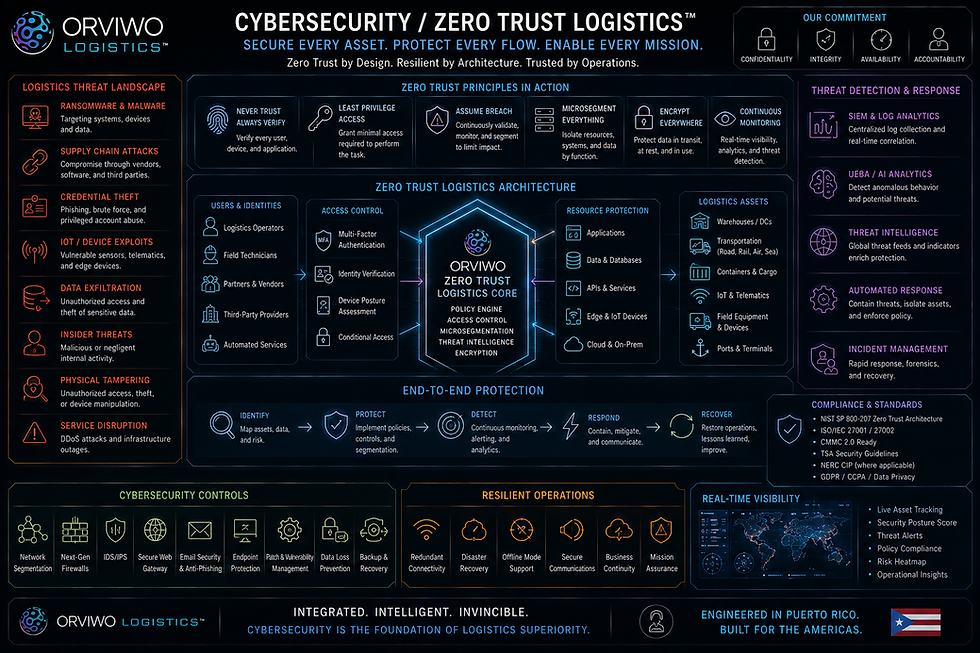
As logistics becomes connected, it also becomes part of the cyberattack surface.
Warehouse systems, IoT sensors, cameras, mobile computers, telematics platforms, APIs, wireless networks, cloud systems, and supplier portals can all introduce risk.
For that reason, cybersecurity should not be added after the logistics architecture is built.
It should be designed into it.
ORVIWO Logistics™ can incorporate principles such as:
Identity → Authentication → Least Privilege → Segmentation → Encryption → Monitoring → Verification
Physical chain of custody and digital chain of trust should reinforce one another.
Puerto Rico as a Strategic Logistics Technology Hub

Puerto Rico occupies a distinctive geographic position between the continental United States, the Caribbean, and Latin America.
For ORVIWO, that geography can support a broader strategic vision.
Rather than viewing Puerto Rico only as an end market, ORVIWO Logistics™ can position the island as a potential location for technology integration, staging, distribution, field support, resilient infrastructure, and logistics intelligence serving regional operations.
The model becomes:
United States / OEM Ecosystem↓Puerto Rico Technology & Logistics Hub↓Caribbean / Regional Distribution↓Latin America / Americas
This aligns logistics with a larger ORVIWO objective:
Engineered in Puerto Rico. Built for the Americas.
ORVIWO Logistics™ +
TacticalAI™

The next evolution of logistics will increasingly involve collaboration between human operators and machine intelligence.
Imagine a logistics command environment receiving information from warehouses, vehicles, suppliers, IoT sensors, transportation systems, weather feeds, inventory databases, maintenance platforms, and field teams.
TacticalAI™ could help correlate those information streams.
Decision Stack™ could organize them into operational priorities.
But the final architecture remains human-led:
Sense → Connect → Correlate → Analyze → Recommend → Human Decision → Execute → Verify
This is ControlledAutonomy™ applied to logistics.
Machines increase awareness and reduce information overload.
People retain authority.
ORVIWO Logistics™ → Quantum Grid™

At its largest scale, logistics becomes another operational layer of the ORVIWO Quantum Grid™.
Individual assets become connected nodes.
Warehouses become intelligent infrastructure nodes.
Vehicles become mobile logistics nodes.
Field teams become operational nodes.
Ports, facilities, communications networks, edge computing systems, AI platforms, and command environments form a distributed information fabric.
The architecture expands:
Asset → Warehouse → Vehicle → Field Node → Edge Intelligence → TacticalAI™ → Decision Stack™ → AIRTDC™ → Quantum Grid™
The result is not simply a smarter supply chain.
It is a distributed logistics intelligence infrastructure.
From Supplier to Point of Need
The future of logistics will be defined not merely by how quickly something moves, but by how effectively organizations understand and control that movement.
Visibility matters.
Connectivity matters.
Cybersecurity matters.
Inventory intelligence matters.
Resilience matters.
Human judgment matters.
ORVIWO Logistics™ brings those principles together into a single mission:
Move the right resource, with the right information, to the right place, at the right time—and maintain visibility throughout its lifecycle.
The doctrine can therefore be summarized in four principles:
Visibility Before Movement.
Know what is moving and why.
Resilience Before Dependency.
Design alternatives before disruption occurs.
Intelligence Before Reaction.
Turn logistics data into operational understanding.
Human Authority Before Automation.
Use technology to strengthen—not replace—responsible decision-making.

ORVIWO Logistics™
From Supply Chain to Mission Readiness.
Smart Warehousing • Asset Visibility • Mission Logistics • Supply Chain Intelligence • Multimodal Distribution • Deployable Logistics • Lifecycle Sustainment • AI-Assisted Decision Support
Engineered in Puerto Rico. Built for the Americas.

$50
Product Title
Product Details goes here with the simple product description and more information can be seen by clicking the see more button. Product Details goes here with the simple product description and more information can be seen by clicking the see more button

$40
Product Title
Product Details goes here with the simple product description and more information can be seen by clicking the see more button. Product Details goes here with the simple product description and more information can be seen by clicking the see more button
$50
Product Title
Product Details goes here with the simple product description and more information can be seen by clicking the see more button. Product Details goes here with the simple product description and more information can be seen by clicking the see more button.
$50
Product Title
Product Details goes here with the simple product description and more information can be seen by clicking the see more button. Product Details goes here with the simple product description and more information can be seen by clicking the see more button.


Comments