

Artificial Intelligence in Healthcare: From Automation to Augmentation
Why the future of healthcare AI depends on governance, resilience, and human accountability.
Healthcare has always balanced two forces: scientific precision and human judgment. Artificial Intelligence (AI) is now reshaping that balance—not by replacing clinicians, but by redefining how intelligence itself is embedded into care delivery.
For years, healthcare AI focused on automation: detecting anomalies, classifying images, flagging risks. These systems delivered efficiency gains, reduced errors, and helped clinicians work faster. But they operated within narrow boundaries—trained to recognize what they had already seen.
Today, a new shift is underway.
Generative AI is not just optimizing workflows; it is changing the nature of interaction between humans, data, and decisions. And that distinction matters.
The real question facing healthcare leaders is no longer “Should we use AI?”
It is “What kind of AI are we building into our systems—and who remains accountable?”
Traditional AI: Precision, Prediction, and Control
Traditional AI systems in healthcare excel at specific, well-defined tasks. They analyze structured and unstructured data to classify, predict, and detect.
These systems power:
Medical imaging diagnostics
Risk stratification and early warning systems
Predictive analytics for patient deterioration
Workflow optimization and capacity forecasting
Their strength lies in consistency and repeatability. Given the same input, they produce the same output—making them well-suited for regulated, high-stakes healthcare environments.
However, traditional AI is inherently reactive. It answers questions we already know how to ask. It does not explain context, generate narratives, or adapt creatively when information is incomplete.
Generative AI: Synthesis, Simulation, and Support
Generative AI represents a fundamentally different capability. Instead of only classifying data, it can generate new representations of knowledge—text, summaries, synthetic data, simulations, and scenarios.
In healthcare, this enables:
Clinical documentation assistance
Patient engagement and conversational interfaces
Synthetic data generation for rare conditions
Drug discovery and molecular design
Decision-support narratives for clinicians and administrators
Generative AI thrives in complexity. It synthesizes across datasets, translates between technical and human language, and supports decision-making when certainty is limited.
But this power introduces new risks. Without governance, generative AI can hallucinate, amplify bias, or obscure accountability. In healthcare, where trust is non-negotiable, unchecked creativity is not innovation—it is liability.
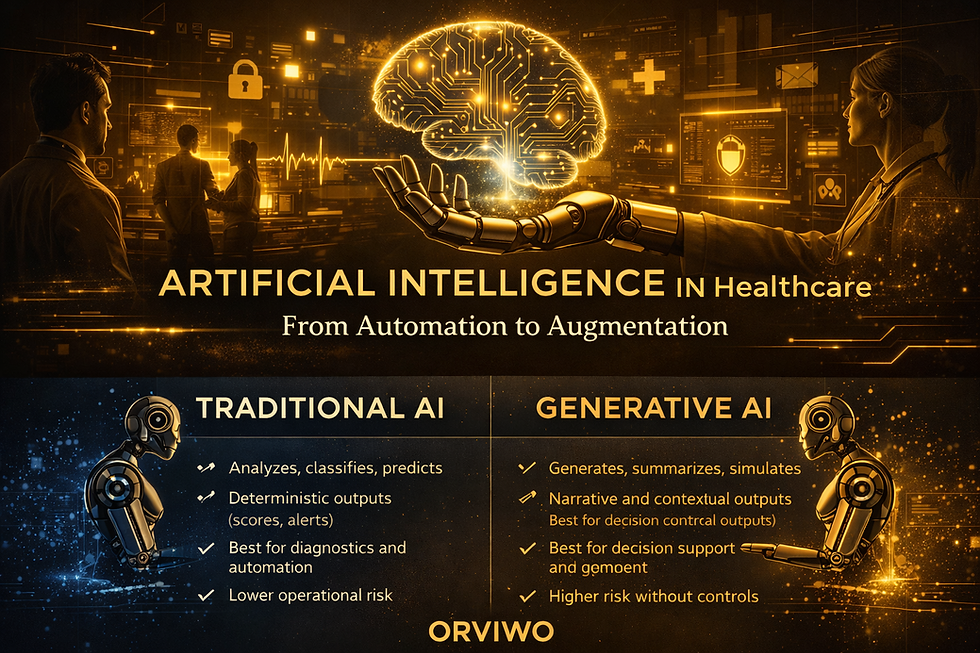
Traditional AI vs. Generative AI in Healthcare
Traditional AI | Generative AI |
Analyzes, classifies, predicts | Generates, summarizes, simulates |
Deterministic outputs (scores, alerts) | Narrative and contextual outputs |
Best for diagnostics and automation | Best for decision support and engagement |
Lower operational risk | Higher risk without controls |
Supports efficiency and consistency | Supports augmentation and insight |
Both are valuable—but neither is sufficient alone.
The Real Opportunity: Hybrid, Governed Intelligence
The future of healthcare is not a choice between traditional AI and generative AI. It is the integration of both—under human authority.
Traditional AI provides guardrails:
Deterministic behavior
Regulatory alignment
Clinical reliability
Generative AI provides connective tissue:
Interpretation and explanation
Communication across roles
Scenario exploration
Operational insight
When combined within secure architectures and governed workflows, these systems support clinicians instead of overwhelming them.
Why Governance Is the Deciding Factor
In healthcare, intelligence without accountability is dangerous.
AI systems must:
Preserve clinician authority
Log decisions and data lineage
Enforce role-based access controls
Operate securely in degraded or disconnected conditions
This is why infrastructure, cybersecurity, and governance matter as much as algorithms.
ORVIWO Perspective
At ORVIWO, we view Artificial Intelligence in healthcare as mission-critical infrastructure—not novelty software.
AI must be:
Secure by design
Governed with human oversight
Resilient under pressure
Integrated into real clinical and operational workflows
When these principles are met, AI becomes a force multiplier—supporting clinicians, protecting patients, and strengthening healthcare systems.
From Automation to Augmentation
AI will not replace clinicians.But clinicians who are supported by secure, governed AI will outperform those who are not.
The future of healthcare belongs to systems that are:
Intelligent
Trusted
Resilient
Human-led
That is the difference between automation and augmentation.

$50
Product Title
Product Details goes here with the simple product description and more information can be seen by clicking the see more button. Product Details goes here with the simple product description and more information can be seen by clicking the see more button

$40
Product Title
Product Details goes here with the simple product description and more information can be seen by clicking the see more button. Product Details goes here with the simple product description and more information can be seen by clicking the see more button
$50
Product Title
Product Details goes here with the simple product description and more information can be seen by clicking the see more button. Product Details goes here with the simple product description and more information can be seen by clicking the see more button.
$50
Product Title
Product Details goes here with the simple product description and more information can be seen by clicking the see more button. Product Details goes here with the simple product description and more information can be seen by clicking the see more button.


Comments