

AI-Ready Imaging Isn’t About AI — It’s About Decision Continuity
How ORVIWO’s Island-Resilient Stroke Reference Architecture (IRSRA) keeps clinical decisions moving when conditions degrade.

Introduction
Hospitals don’t lose patients because scanners stop working.
They lose patients when decisions stop flowing.
In regions like Puerto Rico—where geography, weather, and infrastructure volatility are daily realities—traditional imaging architectures quietly introduce risk. They assume stable networks, predictable transfers, and uninterrupted access to specialists.
That assumption fails under stress.
This is why ORVIWO developed the Island-Resilient Stroke Reference Architecture (IRSRA): an AI-ready imaging framework designed not for ideal conditions, but for the moments when systems are under pressure.
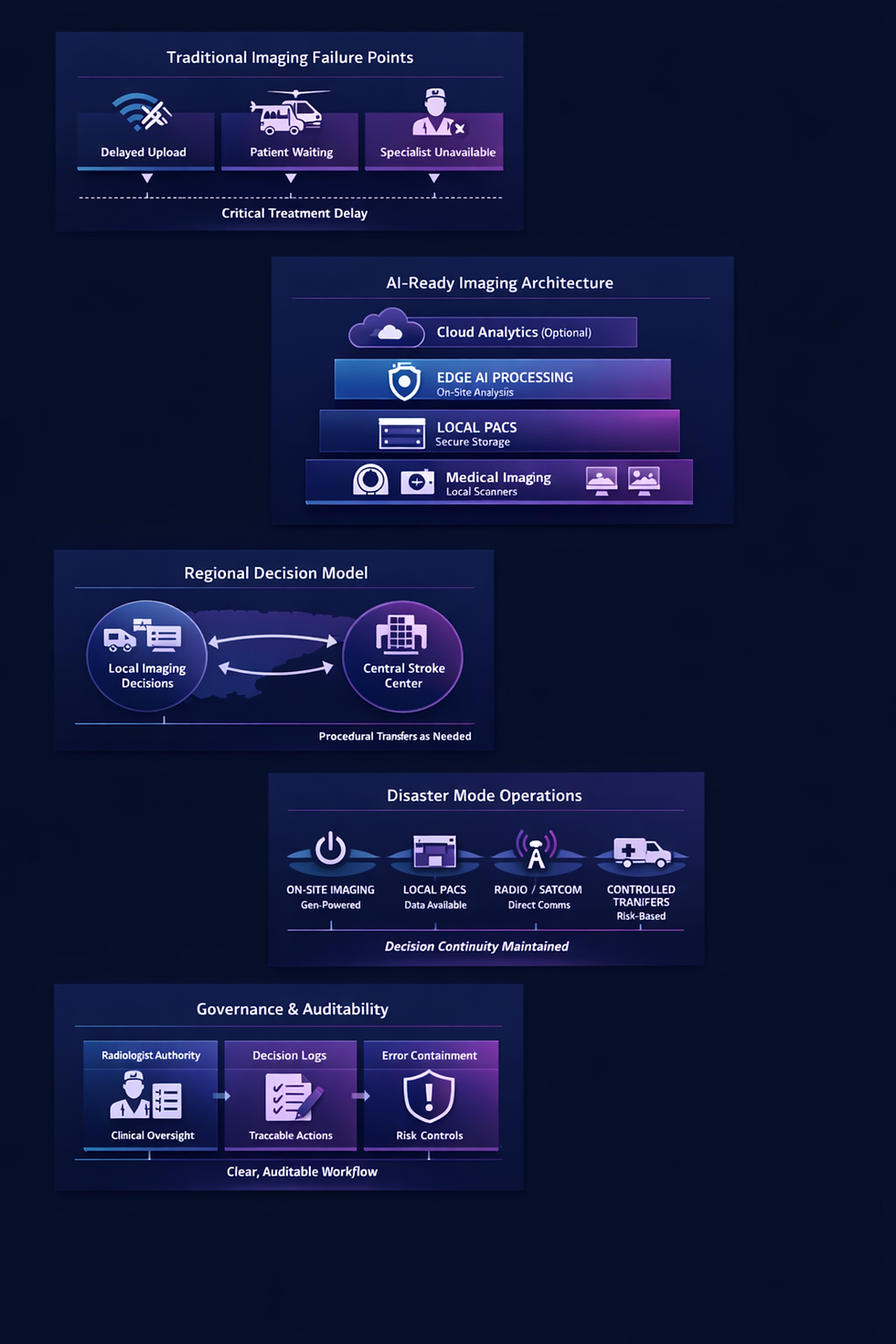
Diagram 1 — The Core Problem
“Where Traditional Imaging Architectures Break”
🧠 What the Diagram Conveys (Without Saying It)
Imaging → decision → transfer is fragile
Dependencies pile up (network, transport, specialists)
Delays compound under stress
Diagram 2 — The IRSRA Architecture
“AI-Ready Imaging as Decision Infrastructure”
IRSRA treats imaging as decision infrastructure—keeping authority local while allowing analytics to IRSRA treats imaging as decision infrastructure—keeping authority local while allowing analytics to
🧠 Board Interpretation
Decisions stay inside the hospital
AI assists locally
Cloud is optional, not required
What “AI-Ready” Actually Means in Medical Imaging
AI-ready does not mean experimental algorithms or cloud-dependent workflows.
In practice, it means:
Imaging decisions run locally, not remotely
Advanced analytics assist clinicians without replacing authority
Systems behave predictably during outages and disasters
IRSRA treats imaging as real-time decision infrastructure, not just storage.
Applied Across Modalities (Not a Single Use Case)
The same architecture supports:
CT – stroke triage, hemorrhage and LVO detection
MRI – faster reconstruction, motion correction
PET – quantitative oncology workflows
X-ray – rapid ED prioritization
Different modalities. One resilient backbone.
Why Island Environments Change the Design
“The architecture changes when geography and disaster risk are real operational factors.”

Diagram 3 — Geographic Logic
“Decisions Stay Regional. Risk Converges Centrally.”
Puerto Rico Island Silhouette — Decision & Transfer Logic (NTI Dark)
“In island environments, imaging decisions remain regional while procedural risk converges centrally “In island environments, imaging decisions remain regional while procedural risk converges centrally “In island environments, imaging decisions remain regional while procedural risk converges centrally
“IRSRA treats geography as an operational variable, not a constraint.”
In Puerto Rico:
Transfers take hours, not minutes
Air transport is weather-dependent
Cellular networks degrade during crises
Specialists are centralized
IRSRA responds with a simple rule:
Decisions stay regional. Procedural risk converges centrally.
Local imaging authority is preserved. Transfers are intentional, not reactive.
The Cognitive Case for Resilience
Under stress, humans perform better when:
Authority is clear
Choices are constrained
Systems behave consistently
IRSRA reduces cognitive load by design:
Imaging decisions stay with radiologists
EMS routing follows predefined logic
AI assists timing, not judgment
This is not just operational efficiency — it is error containment.
Disaster Mode Is a Designed State
IRSRA does not “fail over” during disasters.
It changes mode.
Imaging runs locally on generator power
PACS remains available on-site
Radio and satellite communications take priority
Transfers occur only when benefit outweighs risk
Resilience is not uptime.
It is decision continuity.
Why This Matters to Hospital Leadership
For boards and executives, IRSRA delivers:
Reduced liability exposure
Clear audit trails
Better disaster preparedness
Capital efficiency through software-driven upgrades
Most importantly, it ensures that care decisions continue when conditions degrade.
Closing
AI will continue to evolve.
Cloud services will improve.
But when conditions deteriorate, the hospitals that perform best will be the ones whose decisions never left the building.
That is what ORVIWO’s Island-Resilient Stroke Reference Architecture is designed to do.

$50
Product Title
Product Details goes here with the simple product description and more information can be seen by clicking the see more button. Product Details goes here with the simple product description and more information can be seen by clicking the see more button

$40
Product Title
Product Details goes here with the simple product description and more information can be seen by clicking the see more button. Product Details goes here with the simple product description and more information can be seen by clicking the see more button
$50
Product Title
Product Details goes here with the simple product description and more information can be seen by clicking the see more button. Product Details goes here with the simple product description and more information can be seen by clicking the see more button.
$50
Product Title
Product Details goes here with the simple product description and more information can be seen by clicking the see more button. Product Details goes here with the simple product description and more information can be seen by clicking the see more button.


Comments